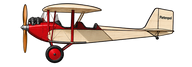

How to Build a Pietenpol Air Camper or Sky Scout Airplane
Explore the family’s construction notes, photographs, and specifications for the Pietenpol Air Camper and Sky Scout. Check construction dimensions against the applicable plans and the configuration of your aircraft.
Pietenpol airplanes built to Bernard H. Pietenpol's plans are straightforward, no-nonsense airplanes. They're great for puddle jumping or even long cross-country trips. They fly low and slow, the same way they have for nearly a century.
Pietenpol Airplanes (Air Camper and Sky Scout) are low in cost, durable and most of all, FUN! Probably the biggest reason they are inexpensive to build is that almost no aircraft-rated materials are required by the design. They are durable because the designer, B.H. Pietenpol, went out of his way to make every part of the ship stronger than necessary.
In short, we have found the Pietenpol Air Camper and Pietenpol Sky Scout to be real honest-to-goodness airplanes, built simply and inexpensively by honest-to-goodness people.
The Air Camper has some interesting design features. Because of the downward thrust of the propeller, (the engine is angled downward 5 degrees) the plane has a short/slow take-off run, and landings are light on the wheels. The beauty of the Air Camper design is, that except for engine changes, more than 60 different engines have been adapted for use on the airplane. The basic plans behind the firewall do not need to change. This aircraft was the first to use the split axle landing gear and was the basis for the 1933 Improved Air Camper plan drawings by Orin Hoopman.
Bernard Pietenpol never lost sight of the cost of flying and showed his true genius in keeping the cost down – within reach of the "common man".
Let's discuss what makes up a Pietenpol Airship ("Air Camper or Sky Scout").
Your own set of "Original Pietenpol Air Camper plans":
To build a Pietenpol Air Camper or Sky Scout, first you need a set of plans (available on this website) and a workbench. For building tips and construction detail, the "Original Air Camper & Sky Scout Builders’ Manual" is recommended.
Fuselage:
The longerons are made of 1 inch by 1 inch Sitka spruce. All struts and braces are milled from 1 inch by 3/4 inch Sitka spruce. All wooden pieces are glued together and held in place with rectangular wood gussets cut from 1/8 inch aircraft-grade plywood, glued down with aircraft glue, and held in place by small aircraft brads while the glue is setting. The forward half of the fuselage is covered on both sides with 1/8 inch aircraft plywood. The plywood only extends from the firewall to back of the rear seat. Once the sides are assembled, they are up-righted on a workbench and joined together with struts and braces cut to provide tapering from the rear seat to the tail where the two sides will join. Quarter inch aircraft plywood is used for the floor of the cockpit, and firewall.
Confirm the required plywood thickness from the applicable drawing before construction.
Turtle Deck:
A turtle deck is created aft rear cockpit seat to facilitate crowning atop rear fuselage. This is accomplished by seven 1 inch x 1/4 inch Sitka spruce stringers set on edge to create what Mr. Pietenpol called a "Streamlined appearance".
Wing:
The wing is a one-piece wing without any dihedral. The wing spans 28 feet 2 inches, giving it 140 square feet. Plans are also available for a three-piece wing of the same length. Building a three-piece wing is recommended when building space is of value. The three-piece wing requires the additional building of a few extra wooden pieces, and metal fittings. The wing is built up with 28 ribs. The ribs are easily built in a homemade jig (no steaming required). Each rib is built out of 1/4 inch by 1/2 inch cap strip. This size cap strip is also used as rig struts which hold the top rib cap strip to the bottom cap strip. All ribs are held together by 1/16 in. aircraft plywood gussets 1 in by 3/4 in. The ribs are hung on two 28-foot-long Sitka spruce spars of identical size (4 3/4 in. x 1 in x 28 foot). Each spar can be made of two 15-foot spars spliced together (very common). If you are building a three-piece wing, each spar is then made up of three smaller length spars, with no splicing required (very common). Leading and trailing edges are made of Sitka spruce and are added.
Tail Feathers:
The tail group (rudder, vertical and horizontal stabilizers) is built just like the fuselage and wings with Sitka spruce spars, wide cap strips, and plywood gussets.
Covering:
The choice is yours! When Mr. Pietenpol built his airships in the 20s and 30s, Ceconite wasn't even invented. Grade A aero cotton was used. Today, Ceconite works well. Newer technologies exist that work very good (Poly Fiber process). The wing, fuselage, and tail feathers are covered. Interior of fuselage is finished with three coats of spar aero/marine varnish, sanding between coats.
Engine:
Over time, Mr. Pietenpol built Air Campers with Ford Model A engines, and lightweight aircraft engines; with appearances from Continental (A-65), Lycoming, Franklin, and yes the boxer-style type Corvair auto engine (110 hp). All very good! Many people are experimenting with other types of auto and aircraft engines.
Fuselage fittings:
The rudder is controlled by simple U-foot pedals attached to the cross members. The control cables are simply fastened to the control stick. All wing and tail feather fittings and the landing gear are built of 4130 aircraft steel.
Changes over the years:
Of course there were changes over the past 65+ years, but mainly to the powerplant. Over time, Mr. Pietenpol built Air Campers with lightweight aircraft engines; with appearances from Continental (A-65), Lycoming, Franklin, and yes the flat-six boxer-type Corvair auto engine. When Mr. Pietenpol used light weight aircraft engines, or Corvair engines, he added 6 inches of length to the fuselage. These and all changes over time are reflected in the Air Camper plans. You can build it with any of these engines. They all work great! Plan on spending 900+ hours of wonderful fun and rewarding time building your Pietenpol Air Camper or Sky Scout!
Construction airplane photos

Sitka Spruce Wood: You do not need much. You also need (1) 4x8 1/4" - (1) 4x8 1/8", - (2) 4x8 1/16" Aircraft Plywood plus 2 square feet of 4130 sheet steel. (AP2)

You will need a flat bench top: turning the bench top into a waist-high jig saves your back. Start with the fuselage first; ribs are so easy they can wait until the end. Remember, everything attaches to the fuselage! (AP3)

Start by putting up your two longerons: 1" x 1" (top and bottom), then insert your struts and braces. 1/8" glued down gusset plates hold everything together. Easy and very strong! (AP5)

Attach 1/8" aircraft plywood sides: Look at these as very large gusset plates. (AP6)

Connect the two fuselage sides: Connect with 1/2" x 1" braces and struts. All held together by 1/8" gussets. Just that simple! (AP7)

Add a 1/4" Aircraft Ply floor: two seat backs, and two wooden seats. (AP8)

Install Turtle Back aft of rear seat: Gives your ship an aerodynamic look. (AP9)

Time to cut a little 4130 sheet steel: You do not need much time or steel. Good winter project! An inexpensive metal band saw, such as one from Harbor Freight, works well for this. Cut out, grind and round corners on a bench top grinder. All metal pieces are primed with zinc chromate primer. A little welding is required. Tig/Mig or Oxy Acetylene all work good. Many people will pre-jig their parts and take them to a local welder who can in minutes weld up what you need. This is a photo Bernard shot. (AP10)

Install all metal fittings on your fuselage, wing, and tail feathers. Andrew used AN-type aircraft hardware (bolts) for this build. (AP11)

Let's bring it all together! Mount your Engine, Put on your landing gear, add instruments. Then it's time to cover!
Additional Construction Photos


Original Pietenpol Air Camper specifications
The Air Camper is a two-seat airplane. Check the specifications below against the plans and configuration of your individual aircraft.

| Seating | Two seats |
|---|---|
| Wing span | 28 ft 2 in |
| Wing chord | 5 ft |
| Wing surface | 140 sq ft |
| Length | 17 ft 8 in |
| Overall height | 6 ft 6 in |
| Tread | 53 in |
| Empty weight | 625 lb |
| Engines listed | Ford A, 65–85 Continental, Subaru, Jabaru, other |
| Useful load | 456 lb (passenger, gas, water, baggage) |
| Climb with light load | Over 500 ft in the first minute |
| Climb with full load | Over 200 ft in the first minute |
| Take-off speed | 60–75 mph |
| High speed | 90 mph |
| Landing speed | 35 mph |
| Fuel capacity | 10–18 gal |
| Take-off run | 150 ft |
| Landing run | 250 ft |
| Complete wing weight | 95 lb |
| Complete body weight | 130 lb |
| Complete motor weight with magneto | 244 lb |
| Radiator weight | 21 lb |
| Propeller weight | 21 lb |
| Total airplane weight with water | 625 lb |
| Gross load | 1,080 lb |
| Load per square foot | 7.7 lb |
The listed empty weight of 625 lb and useful load of 456 lb total 1,081 lb, a one-pound difference from the listed gross load of 1,080 lb.
Original Pietenpol Sky Scout specifications
The Sky Scout is a single-seat airplane. Its dimensions and performance figures are listed below.

| Seating | One seat |
|---|---|
| High speed | 62 mph |
| Cruise speed | 55 mph |
| Landing speed | 35 mph |
| Take-off run | 150 ft |
| Landing run | 250 ft |
| Climb with light load | Over 500 ft in the first minute |
| Climb with full load | Over 200 ft in the first minute |
| Wing span | 27 ft 3 in |
| Wing chord | 5 ft |
| Length | 16 ft 3 in |
| Weight | 610 lb |
| Useful load | 267 lb (person plus gasoline) |
About the Pietenpol Sky Scout
The Pietenpol Sky Scout is a little less in length than it's bigger brother the Pietenpol Air Camper. It is a single-place airplane designed in the 1920s by Bernard Pietenpol. The Pietenpol Sky Scout is very like the Pietenpol Air Camper but with a single seat for the pilot and a unique dampening landing gear. The Pietenpol Sky Scout uses many of the same Air Camper parts.
The Pietenpol Sky Scout was designed and intended for easy inexpensive home construction and to be built from readily-available materials. Wood, fabric, a used Ford Model T or Model A engine was needed. Fewer metal parts and even less minimal welding is required than that of the Pietenpol Air Camper.
Fewer Pietenpol Sky Scouts were built in the 1920's - 40's as it was overshadowed by the two-place Pietenpol Air Camper. The same still holds true today. Bernard Pietenpol designs remain popular today! The Pietenpol Sky Scout continues to be a successful design for the same reasons homebuilders were so fascinated by the design over 85 years ago.
The Pietenpol Sky Scout still has graceful styling, still has those predictable easy flying qualities, still easy construction, and finally still an inexpensive way to fly (Extremely rugged)! The Pietenpol Sky Scout today is the ultimate one man Bush Plane!!! Good/ Great for Barnstorming!
More fun facts and building questions
Are Pietenpol kits available?
Pietenpol Aircraft Company and Aircraft Spruce and Specialty Company have joined together to develop Air Camper Kits that will allow you to build your own Pietenpol Air Camper aircraft. These kits contain all the wooden Sitka Spruce and Aircraft-Grade Plywood you will require to build a Pietenpol Air Camper. These are wood-only kits (just the aircraft-grade woods are included). You will be required to supply your own hardware, engine, and covering. These kits also support all optional Wing, Fuselage and Engine designs. These kits are designed to be built with the Air Camper plans sold and copyrighted by the Pietenpol family on our website.
PIETENPOL VERTICAL STABILIZER KIT
ORIGINAL PIETENPOL RUDDER KIT
ORIGINAL PIETENPOL ELEVATOR KIT
ORIGINAL PIETENPOL HORIZONTAL STABILIZER KIT
ORIGINAL PIETENPOL FUSELAGE KIT
ORIGINAL PIETENPOL WING KIT
To purchase Pietenpol Air Camper aircraft kits, please click the following link >>
Bernard Pietenpol advertised and sold kits in the 1930s and also built a few ready-to-fly airplanes. Members of the Broadhead Pietenpol Association have also made and sold individual components. Pietenpol airplanes are primarily built from scratch, with component kits offering another way to source materials.
How much will it cost to build a Pietenpol?
The cost depends on your engine, materials, instruments, covering system, and how much fabrication and rebuilding you do yourself. Obtain current quotes from your suppliers for the configuration you plan to build.
How much time will it take to build?
Another tough one ... one builder started an Air Camper in November of 1988 and flew it in June of '89. He, too, is an experienced builder and is retired. At the other extreme, one Air Camper flew in 1990 for the first time; some twenty years after it was begun. Experienced builders remind the novice that ''airplane building is just a whole bunch of little jobs.'' Budget yourself about 900+ hours of construction time.
Model A Engines
Many Air Campers are being flown today with the Ford Model "A" engine. Some of these ships are quite old; some are brand new. Many are currently under construction. Five million Model "A" Fords were produced and there are plenty of engines that are available today. When sourcing a rebuildable engine, consider the condition of the block, crank, and cam, along with the work and parts needed for rebuilding, such as new pistons, boring, babbitting, and align boring. Ask a specialist for a current quote.
Start your looking by writing one or both of two national Model "A" Ford clubs: The Model "A" Restorers Club, 24800 Michigan Ave., Dearborn, MI 48124 and/or Model "A" Ford Club of America, 250 S. Cypress St., La Habra, CA 90631-5586. Ask for the name of a chapter near you, then phone an officer and attend a meeting.
Corvair enthusiasts also have a national organization: Corvair Society of America, PO Box 607, Lemont, IL 60439.
Who knows the most about Corvair Aircraft Engines used in the Pietenpol Air Camper?
This is a very easy question to answer: William Wynne, The Corvair Authority.
William Wynne
The Corvair Authority
5000-18 HWY 17 #247
Orange Park, FL 32003
(904) 529-0006
William has spent 25 years professionally researching, testing and developing the Corvair aircraft engine into the reliable, affordable powerplant that it is today. William's two website sites present the subject in depth. William teaches Corvair College where builders can attend and build their own Corvair aircraft engines.
Please click on the links below>>
Where do I obtain the three-piece wing plans?
The plans are available through the family’s website. View the Original Pietenpol Air Camper Three-Piece Wing Plans.
Registration Numbers
Many use B.H. Pietenpol's number NX899 followed by builder/owner's initials (i.e., "NX899AP"). Nice tribute to Mr. Pietenpol.
Are Model "A" Ford engines still available?
Yes, Henry made five million of them and there are plenty still around.
Steel fuselage available?
Yes, we do have the plans.
They are available from this website.
Shouldn't I redesign the _______?
WHY? Why would you want to? It's been working just fine the way it is for the past seven decades. People have been trying to "improve" the Air Camper and Sky Scout for seventy years. And the ones who build a second Piet always build it closer to the original plans than their first! There is a lesson here.
Am I building a Pietenpol?
If the plans you are building from were signed by Bernard H. Pietenpol, it is. If Bernard, Andrew, or Don Pietenpol supplied you with the Air Camper plans, then it is.
If I'm not building a Pietenpol, am I welcome in the Broadhead Pietenpol Association?
Yes, we encourage you to do so!
Can you tell me the minimum length table required to lay out the fuselage (long version)?
168 inches or 14-foot work bench.
We want you to know (this is very important) please read!
The Pietenpol designs have been popular and successful for over seven decades. Like most of the best homebuilt designs, Pietenpols have been copied and modified by some builders. That's a legitimate activity. After all, most are members of the Experimental Aircraft Association. But we think it is unfortunate that the builders who change the design persist in calling their creations Pietenpols.
When looking at airplanes, remember the old adage "Imitation is the Sincerest Form of Flattery." Remember, too, Pietenpol plans are labeled "Designed by B. H. Pietenpol". If you want to build an Original Pietenpol, you need to build from Original Plans. The Pietenpol Family and the Broadhead Pietenpol Association organization suggest you build from authentic Pietenpol plans. Bernard's original, copyrighted Air Camper and Sky Scout plans are available from the Pietenpol family through this website. Printed plans are shipped to you once your order is processed.
Choosing authentic Pietenpol plans
The Pietenpol Family and the Broadhead Pietenpol Association want you to know as prospective Pietenpol builders that on occasion we find builders believing they were using authentic plans, but have actually purchased the plans of others and started to build from them before discovering they weren't building a Pietenpol.
It is not our intent to denigrate the designs of others, nor is it to convince a builder to build one design rather than another. But, as members of a ''type'' club we are sometimes asked by builders for advice or help with their ''Pietenpol'' projects, only to discover the builder is not working on a ''Piet'' at all.